From Monitoring to Maximizing: The Complete Guide to AI-Driven Renewable Energy Asset Optimization
|

Renewable energy portfolios generate more data than most teams can use in real time. Tools like AI solar monitoring and real-time energy storage monitoring give operators visibility. However, visibility alone does not tell a team what matters most or what the financial impact will be.
That’s where AI-Driven Renewable Energy Asset Optimization comes in. It goes beyond monitoring, turning operational signals into a decision layer that helps teams connect performance, risk, and revenue. This allows for smarter decisions, where operational efficiency is measured by actual financial impact.
The monitoring foundation
AI solar monitoring and AI-enabled real-time energy storage monitoring and control give teams a live view of asset behavior. They help detect deviations, compare sites, and keep day-to-day operations moving.
The limitation is familiar. A dashboard can show that an asset is underperforming, but it does not always show whether the issue is technical, contractual, or financially urgent. Most monitoring tools stop at visibility. The step from knowing something is wrong to knowing what to do about it — and in what order — is where performance is lost.
The data quality problem
Before optimization is possible, the data behind monitoring needs to be reliable. Across distributed renewable fleets and tools, that’s rarely a given. Sensor drift, weather variability, and disconnected systems (separate platforms for SCADA, CMMS, and financial reporting) mean that raw performance data is often inconsistent, incomplete, or impossible to compare across sites.
Weather-adjusted performance is a clear example of the gap. A site can appear to be underperforming when the real issue is weather variability rather than a technical fault. Without contract-grade weather-corrected performance ratios and audit-ready documentation, operators cannot confidently distinguish between the two, making escalation, vendor disputes, and financial reporting harder than they need to be.
Data validation is part of optimization. Connecting and cleaning operational data is where the value of AI begins.
The intelligence layer
Operators don’t need more alerts, they need clearer decisions. To achieve that, AI-powered asset optimization platforms close the gap between data sources and reliability. They connect solar, storage, IT, OT, and financial data, then prioritize what needs attention based on impact rather than volume.
The enSights AI framework is built around validated data, financial attribution, and compressed decision latency, which is the ability to move from a performance signal to a prioritized action in the time it takes to review a single dashboard. enSights client Nextcom reduced monitoring time by 50% and cut their reporting from two weeks to hours.
When that process is working correctly, your assets can recover between 2–5%+ of energy production that would otherwise go undetected or unresolved. The result is a more dependable operating model for distributed renewable fleets.
The financial outcome
Once performance data is tied to market signals and storage dispatch, the system actually becomes an AI-powered energy savings platform. That’s where operational visibility starts to affect revenue, margin, and reporting quality.
Teams using enSights have seen a 90% reduction in reporting time, a 7.5% increase in portfolio revenue, and 50% faster vendor resolution. Those outcomes matter because they connect the platform directly to the metrics that finance and operations both care about, translating into improved performance and revenue, reduced operating expenses, scaling ability without hiring and better margins.
For enterprise energy operators, the defining challenge is to "optimize costs and attain business outcomes" and "improve operational availability", not simply to collect more performance data. The platforms that close this loop are the ones that can survive a finance review as well as an engineering one.
What buyers should look for
Buyers evaluating AI-powered asset optimization vendors should look for platforms that:
connect to existing monitoring tools without requiring a full system replacement,
support portfolio-wide workflows across solar and storage, and
produce audit-ready, defensible reporting.
They should also look for explainable prioritization, not opaque scoring, allowing them to show why a specific asset was actually flagged and what the financial consequence of inaction is.
Teams are currently managing performance across a patchwork of systems: standalone SCADA for real-time monitoring, generic BI dashboards for reporting, and disconnected CMMS tools for work order management. Each of these layers adds data fragmentation and slows the path from signal to action. A well-built platform consolidates these workflows without forcing teams to abandon the tools already embedded in their operations.
For teams managing solar and storage together, the platform should support AI-driven renewable energy asset management and optimization without creating parallel workflows or new data silos alongside existing systems.
Why enSights.ai
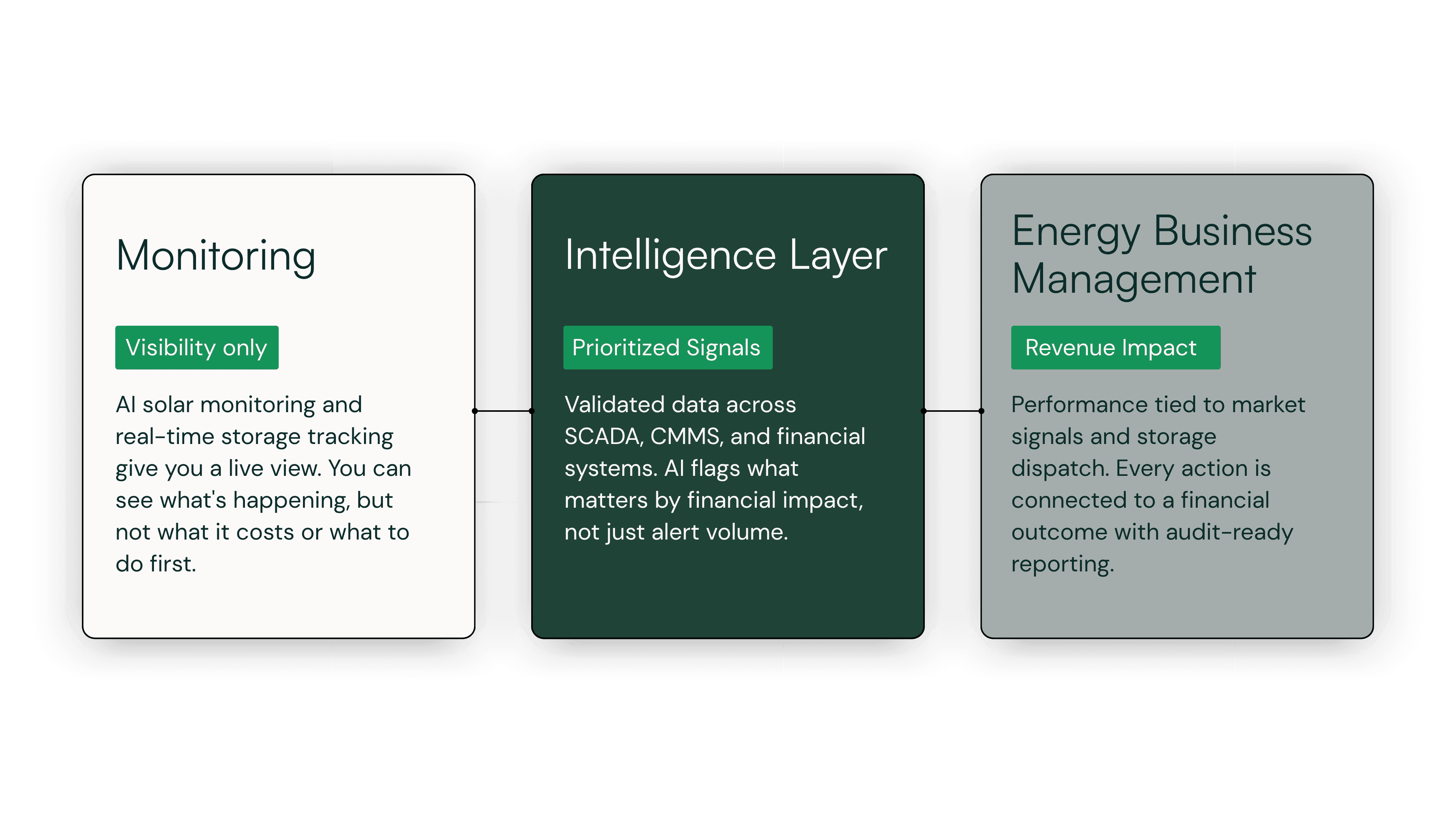
enSights is built as a single decision layer for renewable portfolios, connecting operations, finance, and compliance without replacing the monitoring infrastructure already in place.
Every signal the platform processes is tied to a financial outcome. The goal is not more visibility, it’s decision-ready insight: the right action, at the right time, backed by defensible reporting. That’s what we mean by "One Solution. Every Decision Connected To Revenue" in practice. The standard enSights holds itself to is measured impact and defensible outcomes: reporting that can be shared with investors, relied on in vendor disputes, and used to satisfy regulatory requirements.
If the goal is to move from monitoring to maximizing, the path runs through prioritization, not more dashboards. Faster action, clearer accountability, and outcomes that hold up under scrutiny.
Ready to move from monitoring to maximizing? Explore how enSights.ai connects operational data to financial outcomes.