In This
Article
Welcome to the second edition of our newsletter. Renewable energy is entering a new era. As solar, storage, AI, and electricity markets continue to converge, operating renewable portfolios has become significantly more complex and significantly more important. In every edition, we'll share the market trends, technologies, customer stories, and operational insights shaping the future of renewable energy.
This issue, we're focusing on AI.
01
NEWS
Industry News
With the PJM BESS market booming, why are developers struggling to finance their projects? In an exclusive interview with April Bonner from Energy Storage News, our CEO & Co-Founder, Alon Mashkovich, explained that many developers are still relying on spreadsheets and inaccurate data to calculate complex revenue stacks and forecasts, leading to miscalculations and numbers that fail to stand up to investor and lender scrutiny.
Tackling this challenge will require BESS developers to validate the data behind every revenue stream and connect operational performance directly to financial outcomes.
Across the US market more broadly, solar and storage continue to scale rapidly despite a challenging operational, policy and financial environment, accounting for more than two-thirds of new grid capacity added in the first half of 2026.
While this is welcome news, it also highlights a growing challenge for developers and operators: as portfolios become larger and more complex, fragmented monitoring systems are making it harder to identify where performance issues are putting revenue at risk.
With financial pressures increasing and tax-credit rules tightening, the ability to unify and validate operational and financial data - and understand what revenue is at risk, why, and what action should be taken to recover it - is becoming increasingly important.
02
WHAT'S NEW
New Product Launch
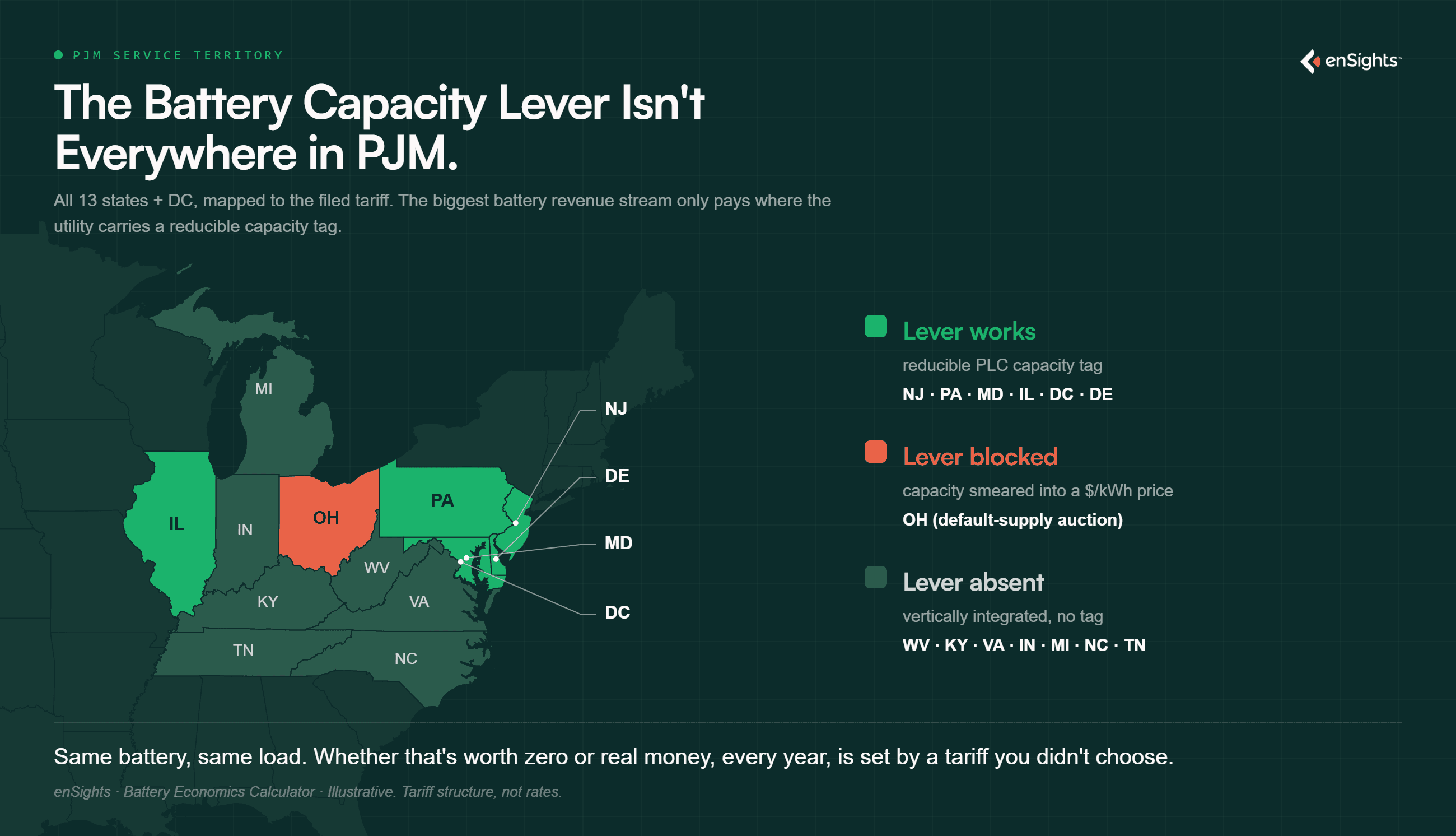
Here is what makes PJM hard.
A battery has six or more revenue streams, they compete for the same state of charge instead of adding up, and the rules underneath them change almost every week. A capacity backstop here, a regulation redesign there, a new state storage program. A spreadsheet built on today's rules is already wrong by next quarter.
So we mapped the whole thing, all 13 states plus DC, to the filed tariff, so an operator can see their real revenue map and which levers actually exist at their site. That map is not the product, it’s the front door to it. We’re building the Battery Economics Calculator into our EMS, because a battery doesn’t need one more control box but needs a system that understands the economics and the rules first, decides from that what the asset should physically do, and keeps deciding as the rules move
We mapped every PJM state to the filed tariff: 13 states plus DC, the actual rate sheets. The battery revenue stream everyone pitches first doesn't exist in much of the footprint.
The marquee play is cutting your Peak Load Contribution to lower capacity charges. In the retail-choice states (New Jersey, Pennsylvania, Maryland, Illinois, plus DC and Delaware) a large C&I bill carries a separate, PLC-based capacity charge. A battery discharging through the coincident-peak hours reduces it. Real money, every year.
In the vertically-integrated parts (West Virginia, Kentucky, Virginia, and most of the fringe) there's no customer capacity tag at all. Capacity is bundled into the regulated rate. A battery can still trim local demand charges, but the PLC lever isn't there. And in Ohio, the default-supply auction blends capacity into a per-kWh price, so PLC isn't reducible on standard service either.
Same battery, same load. Whether that's worth zero or real money every year is set by a tariff you didn't choose. That's why "what will a battery earn in PJM?" has no single answer. Only a per-site one.
Which PJM utility is your site on?
03
NEW DEALS
Welcome Skylight Lending


Skylight Lending, one of our active TPO partners, expanded its residential solar and storage financing into California on June 22, opening its platform to one of the country's largest and most dynamic solar markets. The launch came alongside a refreshed Approved Vendor List, adding new energy storage manufacturer partners to give installers more flexible, bankable options as they compete for business in the state.
California's solar market has shifted heavily toward storage in recent years. Under NEM 3.0, the state's net billing tariff, exported solar power now earns a fraction of what it once did, pushing storage attachment on new systems from roughly 11% in early 2023 to 50–60% today. That's exactly the kind of shift installers need a financing partner to move with, and it's the gap Skylight's newly expanded AVL is built to close.
The expansion reflects Skylight's broader growth and its deepening reliance on our platform as it scales into new states. It's a sign of a strengthening TPO financing partner showing up right where California's market needs it.
Launched TPO offerings in California on June 22
Added new storage manufacturer partners to its Approved Vendor List
Expands Skylight's footprint into one of the largest US residential solar markets
Builds on an existing, growing customer relationship
04
STRATEGY
Everyone Is Talking About AI. Almost Nobody Is Talking About What It Takes to Make It Work.

Deploying AI is the easy part. Building an organization that AI can actually help is the hard part. That's why we built Agentic Energy Business Management: not just a platform that watches your portfolio, but one that lets you create and automate the monitoring, operations, and financial workflows around it.
Setup is frictionless. Upload your contracts, PVSyst files, and PPAs, connect your existing systems through pre-built integrations (QuickBooks, your ERP, your CRM), and you're live. No hardware retrofit required.
Underneath, it's four pillars working together: monitoring across your PV and battery assets, EMS to orchestrate storage dispatch, built-in operations (CMMS, contracts, inventory), and finance and ROI tracking down to early loss detection. Build it around how you actually run your business, and get a straight line from information to execution.
Why this matters
The renewable energy industry has already solved how to connect its assets. The next challenge is getting organizations to trust AI with their business, and that's an operating model problem, not a model one. We think that's where the next generation of renewable energy software gets built.
05
PRODUCT UPDATES
Meet the enSights MCP Connector: Your Data, Now an AI Superpower.

Our new MCP connector plugs your live enSights data straight into the AI tools you already use (Claude, ChatGPT, Cursor, and more), so you can stop clicking through dashboards and start building with your data.
Just ask in plain language: "show me last month's losses in dollars," "which sites have open faults," "build me a QBR for this site," and get the report, the dashboard, or the answer back in seconds, grounded in real generation, storage, and financial data. No exports, no waiting on an analyst.
It's model-agnostic and read-only, built to be secure by default: the moment monitoring your fleet turns into creating whatever you need from it.
06
MEET & GREET
Meet the Team

Pete leads utility and strategic market development at enSights, bringing asset owners and operators a rare cradle-to-grave view of the solar lifecycle. Before enSights, he sold turnkey C&I projects at Eagle Solar & Light, one of the Southeast's leading EPCs, then led sales at We Recycle Solar, North America's largest solar recycling and decommissioning operation. That means he's worked with developers, IPPs, and utilities from both the build side and the end-of-life side of the assets our platform manages.
Quick Facts
Time at enSights: Joined in June as Director of Utilities and Strategic Markets
Focus Area: Utility and strategic accounts across North America, building the utility outbound motion
Favorite Project: An AI voice agent that coaches teammates on onboarding and cold-call training
Fun Fact: In a mentorship learning to build split cane bamboo fly rods
Favorite Hobby: Fly fishing, photography, and paddling Alabama's 132,000 miles of rivers with his wife Lindsay
07
EDITORIAL
AI Alone Doesn't Run an Energy Business. Energy Business Management Does.
When an inverter fails, the question isn't just which one stopped producing. It's how much revenue is at risk, whether it's covered under warranty, and what should happen next. Those are business questions, not AI questions.
Renewable energy software has answered a different question each generation: monitoring told you what's happening, analytics explained why, AI is starting to suggest what should happen next. None of them, alone, answer the one question every energy company actually needs answered: how do we run the business?
That's the layer Energy Business Management provides: connecting operational, financial, contractual, and market data so AI's recommendations turn into work orders, resolved faults, and recovered revenue, not just another dashboard.
08
UPCOMING EVENTS
Where to Find Us Next

CHESSA Energize
Tuesday, September 15 – Wednesday, September 16, 2026
Omni Charlottesville, 212 Ridge McIntire Road, Charlottesville, VA 22903
RE+ 2026
November 17–19, 2026
Las Vegas Convention Center
New York Climate Week
September 20-27, 2026
New York City
Your job is hard. Solar asset managers have to make money from an asset they don’t control, using a resource they can’t schedule, while being held accountable for every dollar they didn’t make.
With the renewable energy industry evolving faster than ever, we'll continue sharing the trends, technologies, and operational insights shaping the future of solar and storage.
Have a topic you'd like us to explore, or a challenge you're facing? We'd love to hear from you.
Sincerely, The enSights Team

enSights is the trusted Energy Business Management (EBM) platform. Built by a team with 10+ years of global energy expertise, it solves the thorniest industry issue: managing revenue-generating distributed solar and storage, at scale.
Unifying established in-house industry systems, enSights connects, validates, and analyzes operational, contractual, and financial intelligence, creating a single trusted business layer and system of action. Combined, this enables owners and operators to understand what revenue is at risk, why, and what action should be taken to recover it.
For years, enSights' independent validation has enabled financial and operational teams to track and forecast revenue against project contracts, manage potential downtime, and monitor ongoing operational liabilities. Only when working together can these teams unlock confident financial and operational decision-making.
With a global footprint, enSights supports large, distributed portfolios across North America and EMEA. The platform is deployed across more than 50,000 sites, processing hundreds of millions of data points daily. Its unique insight into developing and building assets, combined with developing and building software, turns portfolio performance into clear, accountable action.
For more information, visit ensights.ai