The High Costs of Disconnection - How siloed systems drain time, trust, and revenue
|

The High Costs of Disconnection
Why disconnected asset reporting is costing clean energy asset managers their profitability.
Renewable energy asset managers are currently operating in a market unlike any other in recent history. Increasingly restrictive incentives are limiting how many projects make it to the finish line. For asset managers and operations and maintenance (O&M) providers, it’s more critical than ever to ensure operating projects maximize profitability.
Unfortunately, legacy asset reporting systems discourage clear, concise reporting, with disconnected spreadsheets, static PDFs and intense manual labor required to ensure numbers add up at the end of the reporting period.
Even asset managers who use software are juggling multiple, disparate monitoring platforms, vendor portals, and accounting systems that don’t talk to each other. In addition to keeping track of all the data, asset managers must meet growing reporting and profitability expectations from investors, regulators, and internal stakeholders. As clean energy technologies have advanced, the systems to manage and operate them have not kept pace.
Legacy systems were introduced when portfolios of projects were small. Now, with hundreds or thousands of projects being managed by one person, the costs of relying on older systems, both hidden and obvious, are beginning to show—and are putting the profitability of the entire industry at risk.
The Hidden Costs of Manual Work
Asset managers today are no longer dealing with small numbers of projects regionally grouped. In most instances, they have become larger and more geographically dispersed, making the patchwork of legacy systems impossible to navigate. Performance data lives in one platform, while utility bills come through another. Then all that data must be exported into the invoicing spreadsheet and copied, reformatted and checked by hand. And that doesn’t even take into account contracts and SLA terms, which often get buried in someone’s inbox in a flood of other information.
Not only does this take away valuable hours from making sure the assets are performing at their peak, it injects unnecessary risk into the protocols as well. The wasted hours are the most obvious drawback to this approach, but what makes potential errors in the system so challenging to manage? In a system with so many moving parts, mistakes like inaccurate invoices, missed SLA obligations or delayed payments from customers can throw the whole profitability of the project into disarray. Over time, that erodes trust and harms the bottom line.
In an industry where margins are tight, that can mean the difference between success and failure.
Integration Gaps That Slow You Down
Most clean energy asset managers will identify the worst part of their job as the month-end reporting or invoicing. The process is tedious and time-consuming, and includes:
Pulling production and utility data from multiple sources;
Matching performance to contract terms, SLAs, or PPA conditions;
Generating invoices that reflect site-specific structures;
Double-checking for errors before sending any reports to the relevant stakeholders; and
Tracking payments across vendors, asset owners, and service providers.
Instead of doing what they love to do—managing assets at optimum capacity—asset managers are instead drowning in volumes of data with methods almost guaranteed to introduce errors. One billing mistake or a missed SLA update reduces investor confidence, strains vendor relationships or, most damagingly, leaks revenue from the bottom line.
Asset managers would much prefer to improve their assets’ performance and diversify the company’s portfolio instead of cleaning up data and cross-checking reports. Many companies don’t realize, however, that there are energy business management solutions that can short circuit the circle of monthly frustrations and return asset managers to doing what they do best. enSights has introduced software to take tedious reporting time from months to just minutes.
What Automated Reporting Should Actually Look Like
Reports should provide teams and stakeholders with reliable insights without having to do it all by hand. An effective energy business management system can help.
A management system should collect relevant data automatically. Whether it’s monitoring data, utility feeds, weather data, performance logs, or financial data, automatic capture allows all the stakeholders to evaluate everything in one place. Additionally, having one system collate the data allows it to be standardized, clean and ready for immediate use. Manually exporting data runs the risk of introducing human error to the process, which in an era of tight margins is unacceptable.
Using customizable templates allows asset managers to tailor their reporting for each audience, whether those are internal teams, investors or regulators, without having to start from scratch each time. The breadth of available data is nearly limitless. Track profit and losses in real time. Monitor SLA performance to prevent missed deadlines and obligations. Generate tax summaries from the same ecosystem that managed your operations, ready for regulators and accountants to review.
And the best part—asset managers can schedule reports to hit stakeholders’ inboxes precisely when needed: daily, monthly, or after specific events. Since every detail matters, automatic reporting can produce fully white-labeled, polished, and professional reports, ready to send without any last-minute, time-consuming manual formatting.
Smarter Invoicing, Built to Scale
But reports aren’t the only items on asset managers’ agendas that benefit from automation. Accurate invoicing, which can make the difference between profitability and losses, avoids the potential for human error and missed financial opportunities.
By automating the process, site-specific bills are produced based on real-time production data, REC eligibility, and contract terms. Skilled asset managers can handle complex structures like tiered rates, performance bonuses, or service charges with ease. Additionally, dynamic P&L statements offer a consolidated view of actual cashflow vs. performance data, which provides real-time information on a project’s profitability.
Most importantly, every line item in these automatic invoices is backed by real data because it works in conjunction with your monitoring, CMMS, and accounting systems. This prevents gaps and mistakes during handoffs. In its place is faster, more accurate billing that builds trust between stakeholders every step of the way.
The Real Business Impact: What Happens When You Automate
Asset managers receive more than just convenience when reporting and billing are automated. There are tangible benefits that accrue to the business and its bottom line.
Teams report up to a 30% boost in operational efficiency because there is no longer repetitive work that consumes innumerable hours every week. Automated reporting and billing reduce manual handoffs and time spent manually reconciling data. By reclaiming this time, asset managers can devote more attention to strategic portfolio management and stakeholder relations.
It can improve portfolio performance by up to 7.5% because asset managers receive actionable insights more quickly, allowing them to act decisively and preserve revenue. It also provides more accurate reports and fewer missed opportunities created by inaccurate billing. Instead of taking days or weeks to handle reports, reconciliations or invoice generation, an effective business management platform can reduce those weeks to minutes.
It also results in fewer delays for maintenance teams to handle performance problems more effectively and efficiently. An automated system allows 50% faster root-cause resolution, reducing the amount of downtime in an overall portfolio and protecting the asset manager’s bottom line.
Finally, when reporting is clean, timely, and transparent, stakeholder trust increases in the process, too. Whether it’s investors, vendors, or internal teams, everyone has access to the right data at the right time, streamlining operations and increasing profitability across the organization.
Refocus Your Time Where It Matters Most
Streamlining operations for clean energy asset managers is an essential part of building long-term profitability and performance. Instead of wasting time exporting spreadsheets, chasing utility data, or double-checking invoices, they should be focusing on work that makes a difference for the bottom line.
Automated, customized reporting and invoicing can give asset managers valuable time back in their days. With a single source of truth and fewer moving parts, they can shift from reactive busywork to proactive strategy and long-term growth. That means growing portfolios, building stakeholder relationships and driving strong performance—at scale.
Legacy systems weren’t designed to do this kind of specialized work. If this sounds like your operation, it might be time to explore something purpose-built for managing an entire clean energy operation. Learn more about how enSights’ solution for clean energy asset managers brings financial, operational, and performance data into one intelligent ecosystem.
Why are disconnected reporting systems hurting clean energy profitability?
Most asset managers rely on outdated, siloed tools like spreadsheets, PDFs, and multiple unconnected platforms, that make reporting time-consuming and error-prone. These inefficiencies lead to inaccurate invoices, missed SLAs, and delayed payments, eroding profitability and stakeholder trust.
How can automation improve reporting and invoicing accuracy?
Automated energy business management systems continuously collect and standardize data from multiple sources—monitoring, accounting, and utility feeds—eliminating manual exports and reducing human error. Reports can be customized and scheduled automatically, ensuring stakeholders receive timely, accurate, and polished insights.
What does a successful transition to automated systems look like?
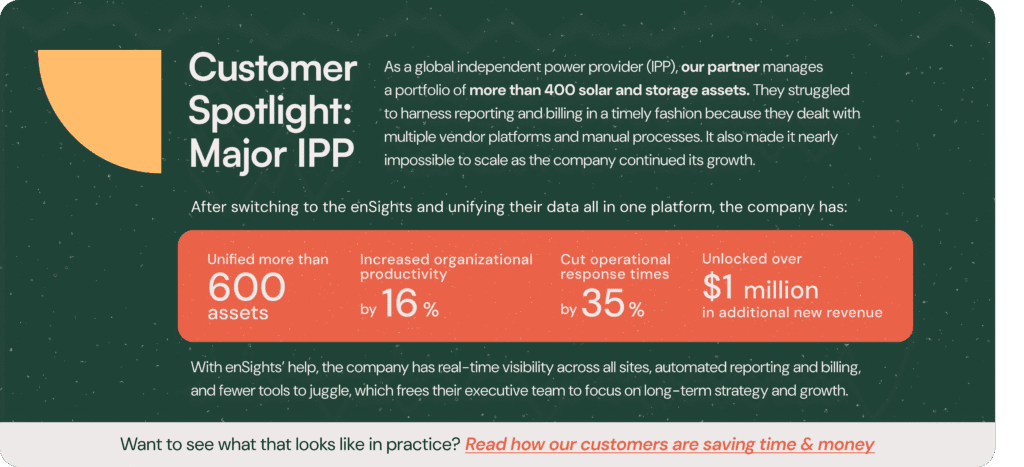
One company, controlling more than 400 solar and storage assets, unified its data through the enSights platform. The company achieved a 12% productivity boost, 40% faster response times, and unlocked over $1 million in new revenue. With automation, they gained real-time visibility and scalability—without expanding their team.
How can I automate my reporting?
The enSights renewable energy asset management platform allows companies to collect all the information, financial, performance and maintenance, in one place. The system then uses that data to generate automatic vendor invoices, asset performance reports and real-time financial information to prevent revenue leakage. Automated reporting and billing reduce manual handoffs and time spent manually reconciling data. By reclaiming this time, asset managers can devote more attention to strategic portfolio management and stakeholder relations.
What tangible business results can automation deliver?
Automated reporting and billing can increase operational efficiency by up to 30% and portfolio performance by 7.5%. Teams spend less time reconciling data and more time optimizing assets, while maintenance issues are resolved up to 50% faster. The result is improved profitability and stronger investor confidence.