O&M challenges and solutions in the evolving clean energy environment
|
O&M challenges and solutions in the evolving clean energy environment
Leveraging AI and automations for task prioritization in a complex and high-demand environment
With aging PV systems, diverse fleets, and an increasingly complex mix of distributed energy resources to manage, operation and maintenance is becoming increasingly difficult. In this new world of clean energy, O&M teams face a variety of business and operational challenges and dilemmas. Prioritizing tasks in a complex and high-demand environment is at the core of resource management and is a key factor in ensuring customer satisfaction, technician efficiency, and cost controls.
However, with numerous variables, it isn’t always easy to decide which issues should take priority. Decision making under pressure, includes considering important questions, like should priority be given to critical customers incurring significant financial losses due to downtime or to clients at higher risk of future dissatisfaction or loss?
And since not all customers are the same, identifying clients who require higher levels of service due to the critical nature of their business or their sensitivity to maintenance problems helps with improving customer satisfaction. In addition, it is an important factor in aligning available resources with varying service levels.
AI and automations improve customer satisfaction, technician efficiency, and cost controls
That’s why optimizing technician deployment is another critical factor to take into account during O&M decision making. Scheduling challenges go far beyond who is available, it involves a much more detailed approach, such as assigning the right people with the right skill sets with minimal travel time in order to minimize costs. By strategizing multi-task operations, managers enable technicians to handle a variety of issues for the same client or multiple clients within the same area. But this can be hard to identify and organize while taking into account many other considerations. One such consideration is the overburdened support systems. There is more data than ever before and this influx of data from various sources, such as customer complaints, wear-and-tear forecasts, and sensors, can be overwhelming – potentially leading to the wrong decisions being made.
Legacy O&M platforms, which were designed as monitoring-first tools, were not built to keep up with these new business demands. Upgrading to a solution that is more than just a single pane of glass for monitoring purposes, but is instead an interconnected ecosystem with standardized data that can monitor KPIs in real time, track maintenance schedules, and quickly identify and prioritize events can greatly improve business efficiency.
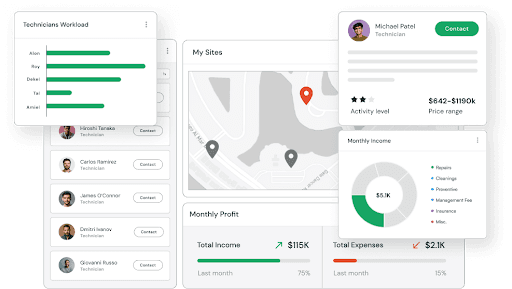
AI-based ecosystems with task prioritization are designed to analyze parameters like issue urgency, potential revenue loss, and resource availability to automate decision-making. These smart resource planning tools optimize technician schedules and locations, integrating navigation and predictive systems. Plus, they provide a customer-centric focus by using metrics to identify key customers, automatic alerts for potential problems, and enhanced customer communication channels.
Smart workflows and automatic KPI tracking are part of a comprehensive and data-driven approach to O&M business management that help to streamline operations, improve service quality, and optimize financial outcomes.
Automation is another key tool to boost operational productivity. This can include the generation of intelligent alerts, actionable maintenance recommendations based on fault history, and streamlining communication and collaboration across teams with smart workflows. These capabilities ensure that resources are efficiently allocated, and issues are resolved proactively, minimizing delays and maximizing uptime.
By leveraging advanced technology, like AI and automation, to effectively address these challenges, O&M leaders can maximize efficiency, enhance customer satisfaction, and reduce costs—delivering greater value to managed assets and ensuring long-term operational success.
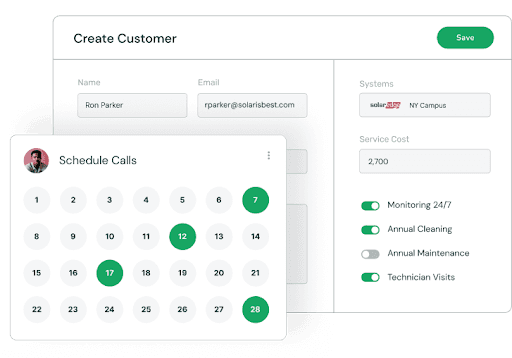
Automation of O&M business operations improves productivity, financial performance, and customer satisfaction by ensuring commitments are met while minimizing manual interventions.
As an example, Nextcom, which operates a 100 MW C&I portfolio, reported a significant improvement in efficiency after implementing an energy management and optimization ecosystem with embedded AI and automation technology. In fact, the company was able to review each system and customer in half the time, leading to faster event resolution and improved reliability.
"enSights has completely transformed the way we manage our assets. Thanks to their solutions, we were able to save twice the time in monitoring, reduce the process of creating automated reports for end customers from two weeks of manual labor to just a few hours, and significantly accelerate the onboarding of new assets with the ability to quickly and efficiently access all of our data—without missing even the smallest piece of information from any system or client.”
- Idan Ben-Moshe, Nextcom Group Inc
Interested in O&M solutions?
Read more about enSight’s AI-driven O&M solutions for your business:
O&M Solutions: Boost your Business Productivity with AI-Driven O&M
Success Story: How enSights helped Solar Medix Cut Costs and Streamline O&M
How Automation and AI Are Revolutionizing O&M in the Clean Energy Sector
What makes O&M task prioritization so difficult in today’s clean energy environment?
Clean energy teams are managing more than ever—aging solar systems, mixed fleets, and a flood of data from sensors and customer calls. Deciding what to handle first isn’t simple: do you fix the outage that’s costing one customer thousands, or respond to another who may walk away if they don’t get attention soon? Add in limited staff and long travel times, and prioritizing tasks can feel like spinning plates.
How can AI and automation make a difference in clean energy O&M operations?
AI and automation help take the guesswork out of decision-making. These tools can scan through all the noise—urgent alerts, maintenance schedules, customer needs—and rank what matters most. They can match the right technician to the right job, minimize travel time, and even flag customers who need extra care. The result is faster fixes, lower costs, and stronger customer relationships.
What’s wrong with legacy O&M platforms?
Most older clean energy O&M platforms were built just to monitor performance. They weren’t designed for today’s challenges, like scaling across large fleets or managing customer expectations. Teams end up wrestling with scattered data, slow reports, and lots of manual work. That wastes time, adds costs, and makes it harder to profit.
Where does automation help the most?
Automation shines in the everyday work that eats up hours. It can filter out false alarms, generate maintenance reports in minutes, and coordinate schedules so technicians aren’t driving back and forth unnecessarily. By taking over these repetitive jobs, automation gives teams more time to focus on solving real problems and keeping systems online.
How can AI improve task prioritization in renewable energy O&M?
AI improves task prioritization by analyzing real-time performance data, revenue impact, SLA commitments, and technician availability to automatically rank and route issues. Instead of manually sorting alerts, teams use an AI-driven Energy Business Management platform to reduce false positives, optimize technician scheduling, and automate workflows. This leads to faster resolution times, lower operational costs, and improved uptime across distributed portfolios.